


Alloy Wire International
Datasheet: Nilo® K
Nilo® K
A Nickel-Iron-Cobalt, controlled expansion alloy containing nominally 29% Nickel and 17% Cobalt. Its coefficient of expansion (which decreases with rising temperature to the inflection point), matches the expansion rate of borosilicate glasses and alumina ceramics.
Nilo® K is also known as Kovar, Dilver, and Pernifer 2918.
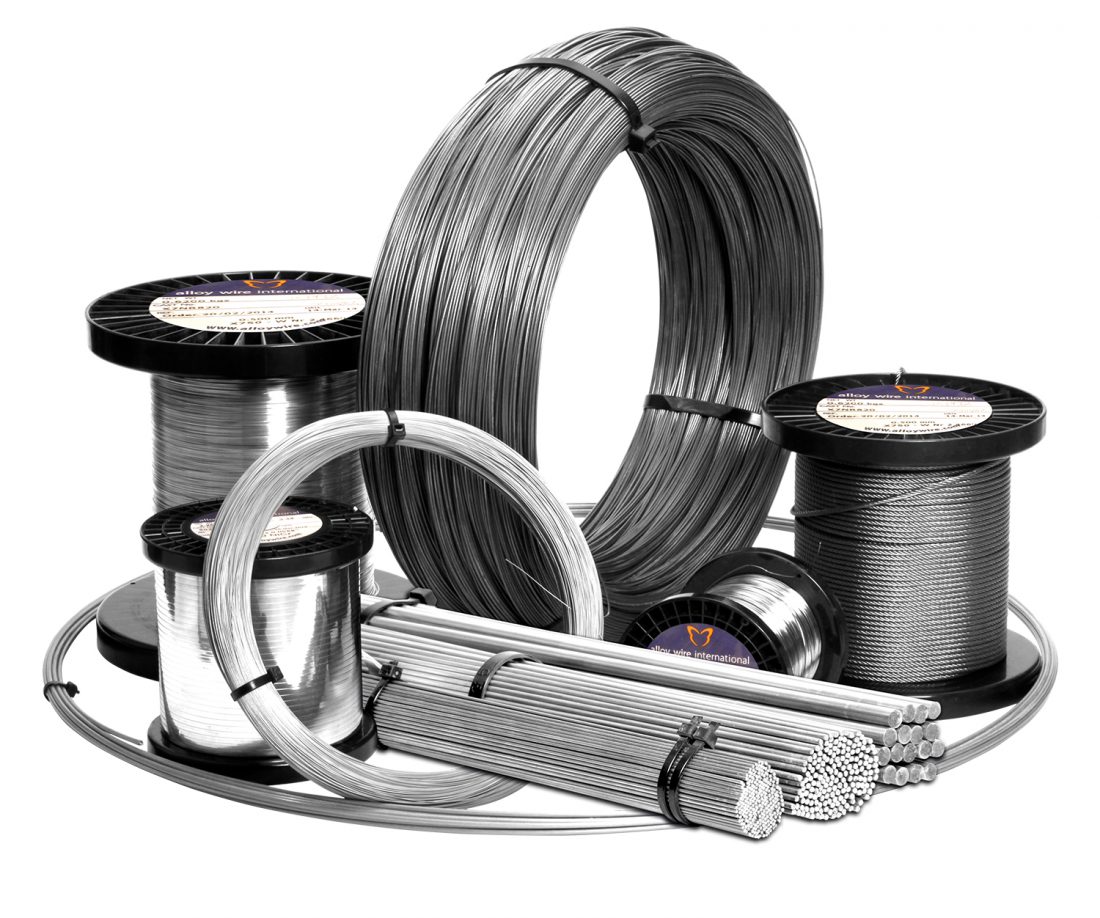
Available in all profile options


Key Features
Nilo® K offers the following key features:
Controlled coefficient of expansion (which decreases with rising temperature to the inflection point).
Matches the expansion rate of borosilicate glasses and alumina ceramics.
Typical Applications
Nilo® K is known to be suitable for the following applications:
Glass to metal seals in applications requiring high reliability or resistance to thermal shock, ie. high power transmitting valves
Designations
W.NR 1.3981
UNS K94610
AWS 094
Specifications
ASTM F15
Chemical Composition
The chemical composition of Nilo® K is indicated in the table below:
| Element | Min % | Max % |
|---|---|---|
| Fe | 53.00 nominal | |
| Ni | 29.00 nominal | |
| Co | 17.00 nominal | |
| Mn | – | 0.50 |
| Si | – | 0.20 |
| C | – | 0.04 |
| Al | – | 0.10 |
| Mg | – | 0.10 |
| Zr | – | 0.10 |
| Ti | – | 0.10 |
| Cu | – | 0.20 |
| Cr | – | 0.20 |
| Mo | – | 0.20 |



Alloy Details
Nilo® K density, melting point, inflection point, thermal conductivity, and coefficient of expansion is indicated in the table below:
| Density | Melting Point | Inflection Point | Thermal Conductivity | Coefficient of Expansion |
|---|---|---|---|---|
| 8.16 g/cm³ | 1450 °C | 450 °C | 16.7 W/m• °C | 6.0 µm/m °C (20 – 100 °C) 4.6 – 5.2 µm/m °C (20 – 400 °C) |
| 0.295 lb/in³ | 2640 °F | 840 °F | 116 btu•in/ft2•h °F | 3.3 x 10⁻⁶ in/in °F (70 – 212 °F) 2.6 – 2.9 x 10⁻⁶ in/in °F (70 – 752 °F) |
Heat treatment of finished parts
The Nilo® alloys are usually supplied and used in the annealed condition (residual cold work distorts the coefficients of thermal expansion). Annealing times may vary due to section thickness.
The typical heat treatment of Nilo® K:
| Type | Temperature | Time | Cooling | |
|---|---|---|---|---|
| Anneal | 850 – 1000 °C (1560 – 1830 °F) | 0.5 Hr | Air or water | |
| To prepare for glass to metal sealing | Decarburization | 900 – 1050 °C (1650 – 1920 °F) | 1 Hr | Air or water |
| If a metal oxide interface is required (time and temperature depend on required oxide thickness) | Oxidize | 600 – 1000 °C (1110 – 1830 °F) | 1 Hr | Air |
Properties
The typical mechanical properties of Nilo® K:
| Annealed | ||
|---|---|---|
| Approx. tensile strength | <600 N/mm² | <87 ksi |
| Approx. operating temperature | up to +400 °C | up to +750 °F |
| Hard Drawn | ||
|---|---|---|
| Approx. tensile strength | 700 – 900 N/mm² | 102 – 131 ksi |
| Approx. operating temperature | up to +400 °C | up to +750 °F |
The above tensile strength ranges are typical. If you require different please ask.
*Trade name of Special Metals Group of Companies