


Alloy Wire International
Datasheet: Nickel® 201
Nickel® 201
A commercially pure Nickel (typically 99.6% Nickel), Nickel 201 is essentially the same as Nickel 200, but with a lower carbon content to prevent embrittlement by inter granular carbon at temperatures over 315°C (600°F). Lower carbon content also reduces hardness, which makes it ideally suited for spinning and cold forming. It is also preferred to Nickel 200 for applications involving exposure to temperatures above 315°C (600°F).
Nickel® 201 is also known as Phyweld 201.
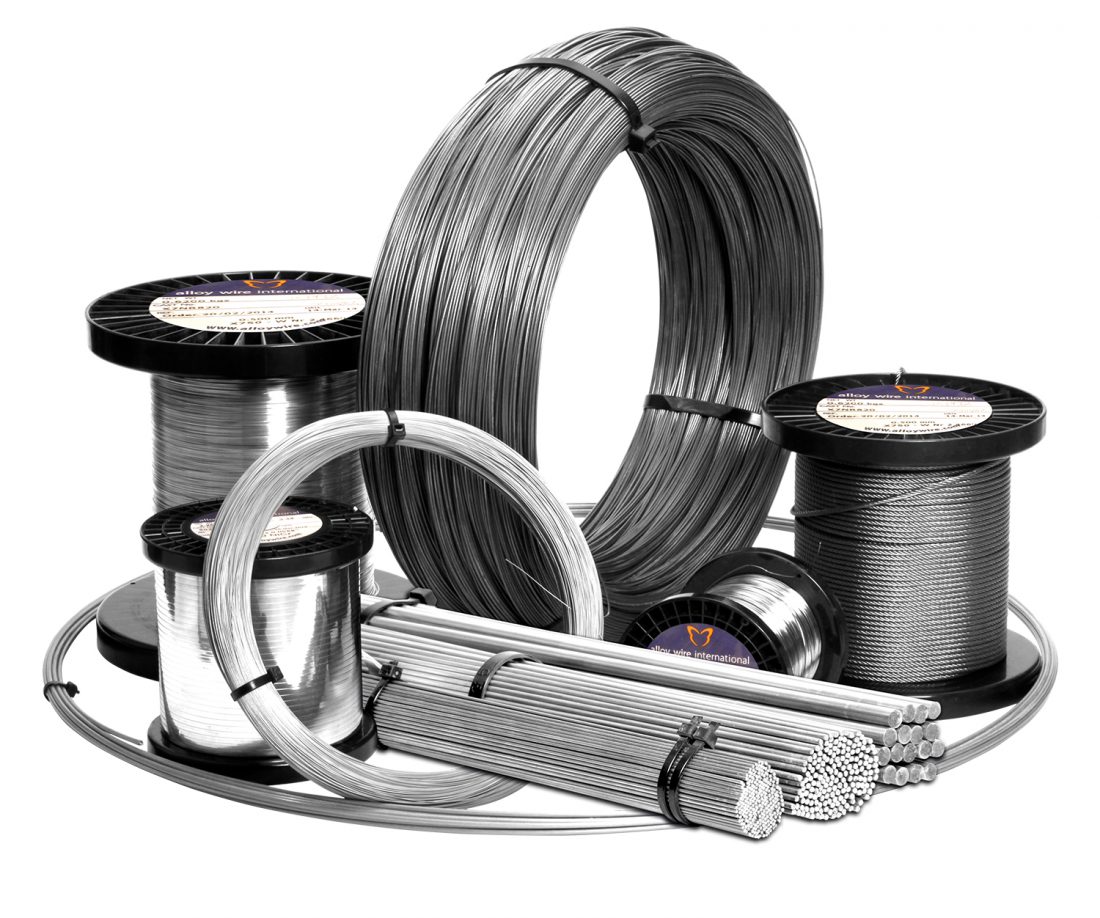
Available in all profile options


Key Features
Nickel® 201 offers the following key features:
Low-carbon version of Nickel 200.
Preferred to Nickel 200 for applications involving exposure to temperatures above 315°C (600°F).
Resistant to various reducing chemicals & caustic alkalies.
Good magnetostrictive properties.
High electrical and thermal conductivity.
Good ductility and low work hardening rate.
Good weldability and solderability.
Typical Applications
Nickel® 201 is known to be suitable for the following applications:
Electronic components
Electrical components
Lead in wires for heating elements
Battery connections/terminals
Chemical processing
Aerospace components
Food processing
Synthetic fibre processing
Designations
W.NR 2.4061
W.NR 2.4068
UNS N02201
AWS 071
Specifications
ASTM B160
ASTM B162
BS 3076 NA12
Chemical Composition
The chemical composition of Nickel® 201 is indicated in the table below:
| Element | Min % | Max % |
|---|---|---|
| Ni | 99.0 | – |
| Cu | – | 0.25 |
| Fe | – | 0.40 |
| C | – | 0.02 |
| Si | – | 0.35 |
| Mn | – | 0.35 |
| Mg | – | 0.20 |
| Ti | – | 0.10 |
| S | – | 0.01 |
| Co | – | 2.00 |


Alloy Details
Nickel® 201 density, melting point, coefficient of expansion, modulus of rigidity, and elasticity is indicated in the table below:
| Density | Melting Point | Coefficient of Expansion | Modulus of Rigidity | Modulus of Elasticity |
|---|---|---|---|---|
| 8.89 g/cm³ | 1446 °C | 13.1 μm/m °C (20 – 100 °C) | 82 kN/mm² | 207 kN/mm² |
| 0.321 lb/in³ | 2635 °F | 7.3 x 10⁻⁶ in/in °F (70 – 212 °F) | 11893 ksi | 30000 ksi |
Nickel® 201 electrical resistivity is indicated in the table below:
| Electrical Resistivity | |
|---|---|
| 8.5 μΩ • cm | 51 ohm • circ mil/ft |
Nickel® 201 thermal conductivity is indicated in the table below:
| Thermal Conductivity | |
|---|---|
| 79.3 W/m • °C | 550 btu • in/ft2 • h • °F |
Properties
The typical mechanical properties of Nickel® 201:
| Condition | Approx. tensile strength | Approx. operating temperature |
|---|---|---|
| Annealed | <500 N/mm² (<73 ksi) | Tensile strength and elongation drop significantly at temperatures above 315 °C (600 °F). Service temperature is dependent on environment, load and size range. |
| Hard Drawn | 700 – 900 N/mm² (102 – 131 ksi) | Tensile strength and elongation drop significantly at temperatures above 315 °C (600 °F). Service temperature is dependent on environment, load and size range. |
The above tensile strength ranges are typical. If you require different please ask.
*Trade name of Special Metals Group of CompaniesConductive